
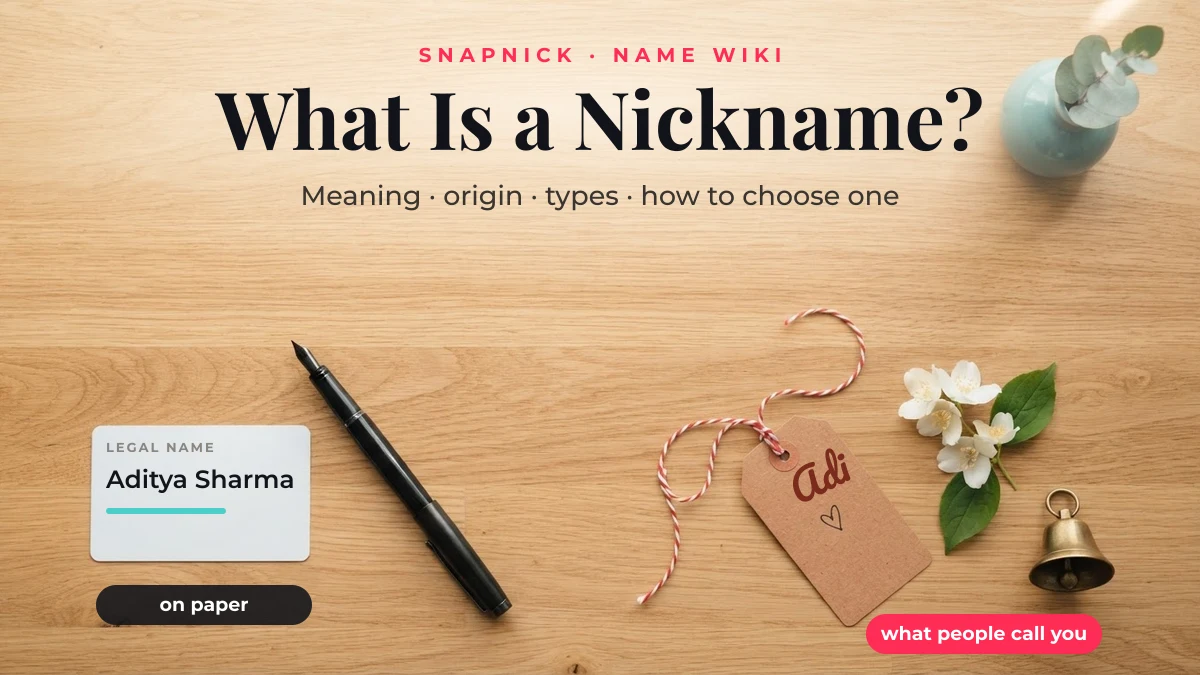
A nickname is an informal name used instead of, or alongside, a legal name — Adi for Aditya, Golu for a round-cheeked child, or a profile name on Instagram or TikTok. The word began as “an ekename”, meaning “an additional name”, recorded in 1303, and became “a nickname” by the 15th century.
What is a nickname?
A nickname is a name other people (or you yourself) use in place of your official name, usually because it is shorter, warmer or more fitting. It can be a cut-down version of the real name, a pet name from family, a description of a trait, or a handle you pick for the internet. What makes it a nickname is not its form but its status: it is informal, and nobody needs a document to use it.
The Wikipedia article on nicknames describes it as “an informal substitute for the proper name of a person, place, or thing” and separates it from a pseudonym, a pen name, a stage name and a title, while admitting the ideas overlap. That overlap is exactly where most confusion comes from, so this page treats each of those names separately further down.
Three quick examples show the range:
- Liz for Elizabeth — a shortened nickname the owner often chooses herself.
- Chotu for the youngest child in a family — a pet name given by others, from the Hindi word for small.
- Master Blaster for Sachin Tendulkar — a public nickname earned by reputation, never used on paper.
What does “nickname” mean?
“Nickname” means an extra, informal name for someone or something. As a noun it is the name itself (“Her nickname is Pinky”); as a verb it is the act of giving one (“The class nicknamed him Lambu”). It is pronounced NIK-naym, with the stress on the first syllable.
Close words carry slightly different shades of meaning:
| Word | What it usually means | Example |
|---|---|---|
| Nickname | Any informal name used instead of or alongside the real one | Adi, Golu, Thala |
| Pet name | An affectionate nickname, mostly used by family or a partner | Munni, Jaanu, Babu |
| Sobriquet | A formal-sounding word for a descriptive nickname, often used in journalism | “Captain Cool” |
| Moniker | Informal word for any name or nickname | “He goes by the moniker Rocky” |
| Handle | A nickname used online, especially a unique username | @adi.clicks |
| Alias | A different name used to hide or replace an identity; often has a legal or criminal tone | “Also known as …” |
Nickname meaning in Hindi and other Indian languages
In Hindi the closest everyday phrases are ghar ka naam (home name) and pyaar ka naam (love name); the dictionary word upnaam covers nickname but can also mean a pen name, an alias or, in some usage, a surname. Bengali families distinguish a daak naam (call name) from a bhalo naam (good name) — the Wikipedia article on Bengali names notes that the good name goes on legal documents while the call name is used by family and close friends. In Tamil, a pet name is a chella peyar.
Where does the word “nickname” come from?
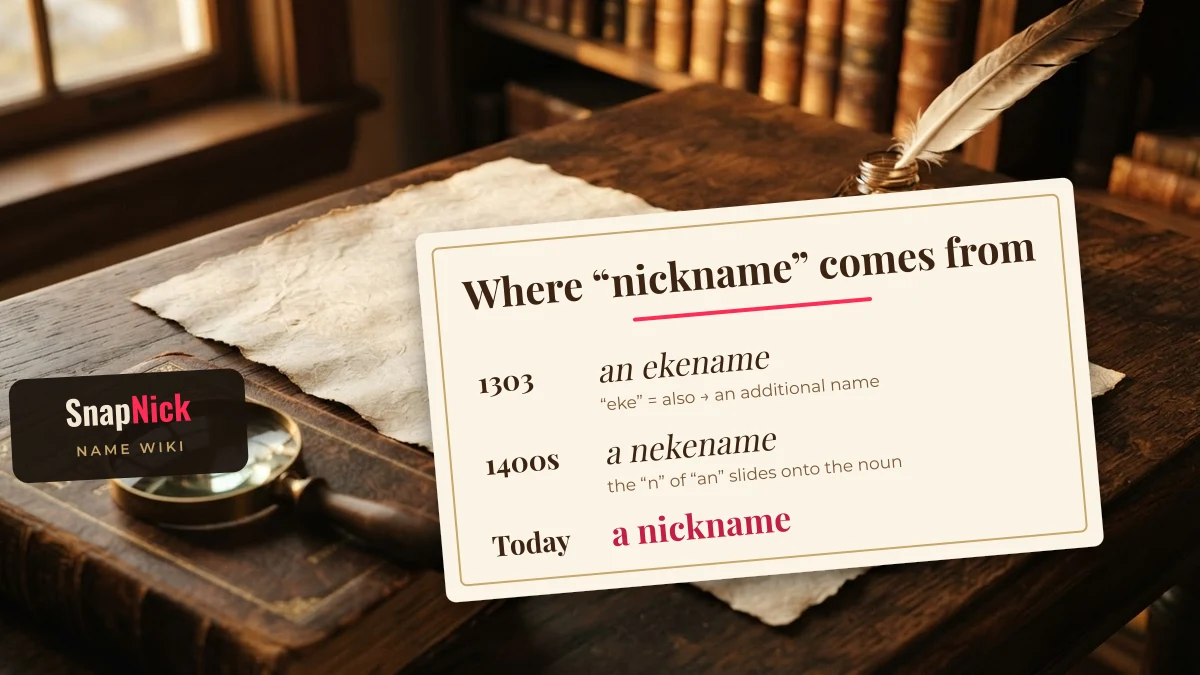
“Nickname” comes from the Middle English ekename, “an additional name”, recorded as early as 1303. Eke meant “also” and goes back to the Old English eac. People said “an ekename”, and by the 15th century the n of “an” had slid across to the noun, giving “a nekename” — the spelling that became “nickname”.
Linguists call this slide rebracketing: the boundary between two words moves because both versions sound the same when spoken. The same thing happened in reverse to “a napron”, which became “an apron”. So a nickname is, quite literally, an “also-name” — and the meaning has barely moved in more than 700 years, even though the spelling did.
It has nothing to do with the name Nick, and nothing to do with “nicking” (stealing) a name, two guesses that come up often.
What are the main types of nicknames?
Most nicknames fall into six types: shortened names, pet names, descriptive nicknames, ironic nicknames, relationship nicknames and online handles. A single nickname can belong to two types at once — Golu is both a pet name and a description.
| Type | How it is formed | Examples | Usually given by |
|---|---|---|---|
| Shortened (diminutive) | Front, middle or end of the real name, sometimes with -u, -i or -y added | Abhi, Sid, Liz, Deepu | The owner or anyone |
| Pet name (hypocoristic) | A soft, often doubled sound that shows affection | Munni, Guddu, Jaanu | Family, partner |
| Descriptive | A trait, habit, skill or look | Lambu, Chotu, Master Blaster | Friends, fans, classmates |
| Ironic | The opposite of the trait, as a joke | Tiny for a very tall friend | Friends |
| Relationship | The role someone plays for you | Didi, Bhaiya, Thala (leader) | Siblings, a community |
| Online handle | Chosen for a platform, often unique and styled | adi.clicks, 𝓐𝓭𝓲 ✦ | The owner |
Shortened nicknames
A shortened nickname keeps part of the real name — usually the first syllable or two. English does it with Alex, Kate and Liz; Indian families do it with Abhi, Anu and Sid, then often add -u or -i to make it softer (Raju, Deepu). The Wikipedia article lists the same tricks used for centuries: taking the front, middle or end of a name, dropping letters, and adding endings like -ie or -y.
We measured how much shorter these names get. Across 12 common name pairs, a nickname cut the length from an average of 7.5 letters to 4.0 — roughly 47% fewer letters to say or type.
| Full name | Letters | Nickname | Letters | Shorter by |
|---|---|---|---|---|
| Abhishek | 8 | Abhi | 4 | 50% |
| Aditya | 6 | Adi | 3 | 50% |
| Siddharth | 9 | Sid | 3 | 67% |
| Priyanka | 8 | Priya | 5 | 38% |
| Anushka | 7 | Anu | 3 | 57% |
| Vikram | 6 | Vicky | 5 | 17% |
| Deepika | 7 | Deepu | 5 | 29% |
| Rajesh | 6 | Raju | 4 | 33% |
| Nikhil | 6 | Nikki | 5 | 17% |
| Elizabeth | 9 | Liz | 3 | 67% |
| Alexander | 9 | Alex | 4 | 56% |
| Katherine | 9 | Kate | 4 | 56% |
| Average | 7.5 | — | 4.0 | 47% |
Pet names (hypocoristic nicknames)
A pet name is a nickname whose main job is affection. Linguists call it a hypocorism, from a Greek word meaning “to call by endearing names”. Pet names are usually one or two syllables, end in a soft vowel and often repeat a sound — Munni, Guddu, Bubbly. Couples have their own layer of them; if you are looking for one for a partner, the list of nicknames for a boyfriend sorts them by mood, from sweet to funny.
The same softening works in English, where a name is clipped and given -y or -ie. That is why so many cute nicknames sound like Bunny, Cookie or Peachy even when they have nothing to do with the person’s real name.
Descriptive nicknames
A descriptive nickname names a trait: height (Lambu), size (Chotu), speed, a skill or a habit. Public figures collect them — Sachin Tendulkar is “Master Blaster”, and Chennai cricket fans call MS Dhoni “Thala”, which Wikipedia glosses as “leader” in Tamil. Descriptive nicknames are the most memorable type and also the riskiest, because a trait can be praised or mocked (see the section on harmful nicknames below).
Ironic nicknames
An ironic nickname says the opposite of what is true: Tiny for the tallest boy in class, Speedy for the friend who is always late. British tradition has many — Lofty for a short man, Curly for a bald one. Irony only works between people who already like each other; from a stranger it lands as a jibe.
Relationship nicknames
Some nicknames describe your place in someone’s life rather than you: Didi and Bhaiya for elder siblings, Chachu for an uncle, “Bestie” for the friend who has seen you at your worst. Friend groups invent the most specific ones, built on inside jokes — the best friend nicknames collection shows how pairs turn a shared memory into a name only two people understand.
Online handles and in-app nicknames
Online, “nickname” often means the name you pick for yourself on a platform. The idea is old: on Internet Relay Chat, the chat system from the late 1980s, every user had to connect with a “nick”. Apps still use the word today. TikTok’s Help Center, checked on 16 September 2026, has separate articles titled “Changing your nickname” and “Changing your username” — the nickname is the profile name people see, the username is your unique @handle. Instagram lets you set a nickname for someone inside a single chat, which only shows in that conversation, and games such as Free Fire call your in-game player name a nickname.
Nickname vs username vs display name vs pen name: what is the difference?
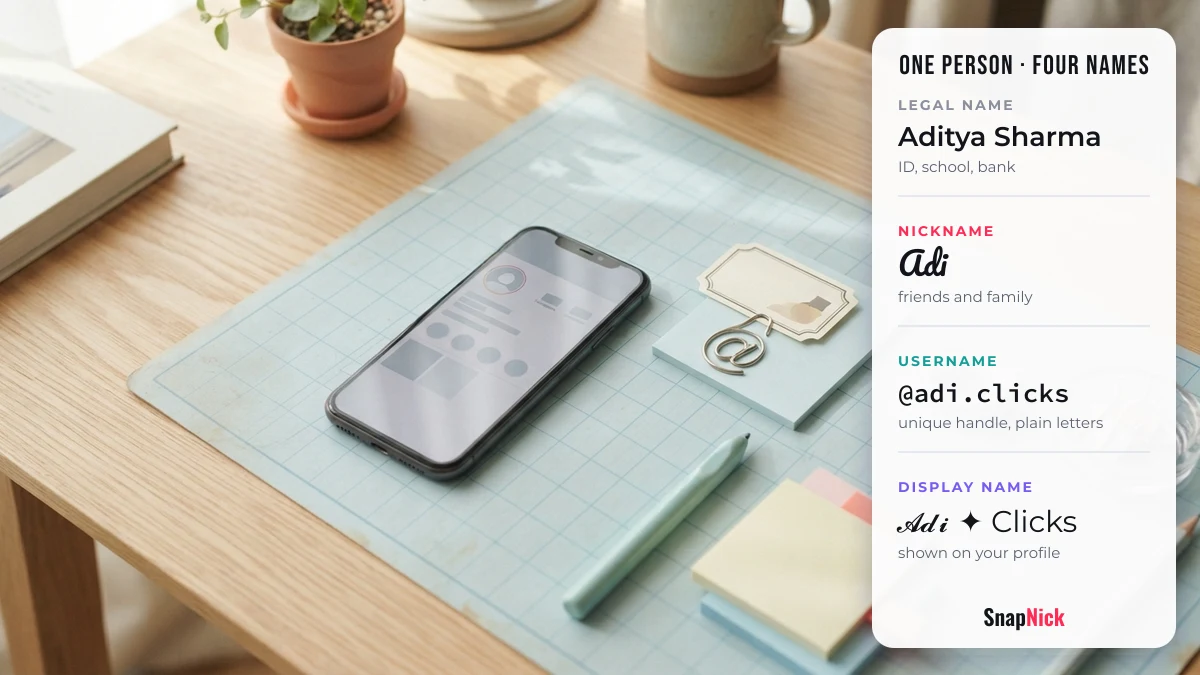
A nickname is informal and can be shared by many people; a username is a unique, plain-text address on one platform; a display name is the public label on a profile and can be styled; a pen name or stage name is a professional identity used on published work. Your legal name is the only one printed on official documents.
| Name | What it is | Who picks it | Must be unique? | Example |
|---|---|---|---|---|
| Legal name | Name on birth certificate, ID and school records | Parents; changed only through a legal process | No | Aditya Sharma |
| Nickname | Informal name used by people who know you | Others, or you | No | Adi |
| Username | Unique handle and profile address on one app | You | Yes, per platform | adi.clicks |
| Display name | Public label shown on a profile; can hold symbols or styled letters on many apps | You | No | 𝓐𝓭𝓲 ✦ Clicks |
| Pen name | Name an author publishes under | The author or publisher | No | Premchand |
| Stage name | Professional name used by a performer | The performer | No | Akshay Kumar |
The lines blur in real life. The writer Premchand was born Dhanpat Rai; his uncle nicknamed him “Nawab”, his first pen name was “Nawab Rai”, and only later did he publish as Premchand — a nickname that grew into a pen name. The actor born Rajiv Bhatia works under the stage name Akshay Kumar and is called “Khiladi Kumar” by the media: one person, three kinds of name.
On social apps the practical rule is to keep the username plain and put the personality in the display name. For Instagram specifically — which characters the username accepts, and what the Name field allows — the guide to nicknames for Instagram sets out the Help Center rules side by side.
How do nicknames work in Indian families?
In many Indian homes a child gets a pet name long before the official name is used — often in infancy — and it can stick for life. Relatives may know someone only as Bunty or Guddi, while school, college and office know the legal name. The Wikipedia article on Indian names notes Marathi home names such as Dada, Bandu and Balu, and that a nickname can take the respectful suffix -ji to show closeness.
These are 30 home names heard across Indian households. Tap any to copy it:
We checked the patterns in this list of 30 with code on 16 September 2026:
| Pattern | Names | Examples |
|---|---|---|
| Ends in -u | 14 of 30 | Pappu, Golu, Chintu, Bittu |
| Ends in -i or -y | 14 of 30 | Pinky, Munni, Sweety, Bunty |
| Ends in -a | 2 of 30 | Munna, Gudiya |
| Doubled consonant (pp, dd, nn, tt…) | 10 of 30 | Pappu, Guddu, Munni, Nikki |
| Five letters or fewer | 26 of 30 | Golu, Monu, Sonu, Dolly |
So 28 of the 30 end in a soft -u, -i or -y, and the average length is 5.0 letters — short enough for a toddler to say. Many carry a meaning: Golu comes from gol (round), Chotu from chhota (small), Guddu, Guddi and Gudiya point to a doll, Munna and Munni mean “little one”, Lambu means “tall one”, and Chiku is the sapodilla fruit. A second group — Sweety, Honey, Lucky, Happy, Dolly, Pinky — is borrowed straight from English words.
Home names travel badly. A name like Pappu, used lovingly at home, is also slang for someone naive, so the same word that sounds sweet from a grandmother can be used to tease at school.
Why do people use nicknames?
People use nicknames for five main reasons: affection, convenience, belonging, telling people apart, and privacy online.
- Affection — a pet name signals closeness; only people inside the circle use it.
- Convenience — Siddharth becomes Sid because one syllable is quicker to call across a playground.
- Belonging — a friend group or team that shares nicknames shares an identity.
- Telling people apart — two Rahuls in one class quickly become “Rahul S” and “Tall Rahul”.
- Privacy and identity online — a handle lets you be recognisable in a game or chat without giving out your full name.
How do you choose a good nickname?
A good nickname is short (one or two syllables), easy to say, linked to something the person likes about themselves, and one they are happy to hear in public. Follow these six steps:
- Decide where it will be used — at home, among friends, on a profile or in a game. A pet name for home can be softer than a handle for a public account.
- Pick a source — part of the real name (Abhi), a trait they are proud of (Flash), a shared memory, or simply a sound you both like.
- Keep it short — say it aloud five times. If it trips your tongue, trim it.
- Run the smile test — would they be pleased if you shouted it across a crowded room? If not sure, ask.
- Style it for online use — type it into the generator below and copy a version with symbols or styled letters for a display name.
- Check the platform — keep a plain version for the username, since many apps only accept letters, numbers, periods and underscores there. WhatsApp’s Help Center gives the profile name a 25-character limit (read by the SnapNick team on 16 September 2026).
If nothing from the person’s name works, build one instead: blend two names, flip syllables or borrow a word from a hobby. The unique nicknames guide breaks this into five repeatable formulas with worked examples.
Matching emojis (tap to copy)
Nicknames shared by visitors
🆕 Just added for
Share your own nickname
That panel is the same SnapNick nickname generator as on the homepage. Here is what it produced for three nicknames from this page on 16 September 2026 — note how styling changes the length: plain Golu is 4 characters, while ♡ 𝔾𝕠𝕝𝕦 ♡ uses 12 UTF-16 units, the way many apps count text.
Golu, Pinky and Adi styled by the generator
Frames and symbols people add around a nickname
Swap “name” for your own nickname, or copy a single symbol to put before or after it. If one shows as an empty box on your phone, paste it into the app anyway — it often displays correctly there.
Kaomoji people send with a pet name
In chats a pet name rarely travels alone. These kaomoji add the tone — shy, happy, a hug or a pout — without spelling it out:
When does a nickname become bullying?
A nickname becomes bullying when it is used to mock, keeps going after the person has asked people to stop, or targets something they cannot change — skin colour, weight, a disability, an accent, or family background. At that point it is name-calling, and repeated name-calling is one of the most common forms of bullying.
| Question | Friendly nickname | Hurtful label |
|---|---|---|
| Does the person use it about themselves? | Yes, or they smile at it | Never |
| What is it based on? | A chosen interest, a shared joke, their name | Body, skin, disability, family or community |
| Who uses it? | Close friends and family | A group, often in front of others |
| What happens when they object? | People stop | It gets louder |
| Where does it appear? | In person, in private chats | Comments, group chats, public posts |
If you are on the receiving end, say clearly once that you do not like the name, then tell a parent, teacher or manager if it continues. Online, block the account and use the app’s report option; cyberbullying leaves screenshots, so save them. In India, online harassment can also be reported through the national cyber crime helpline, 1930. If you gave someone a nickname and they flinch at it, the kind move is simple: drop it and use their name.
Questions people ask about nicknames
What does a nickname mean?
A nickname means an informal, additional name for a person, place or thing, used instead of or alongside the official name. It often shows affection or describes a trait — for example Chotu for the youngest child.
What is a nickname with an example?
A nickname is an informal name such as Abhi for Abhishek, Lambu for a tall friend, or Master Blaster for Sachin Tendulkar. Each replaces the real name in everyday speech without changing it on paper.
What is the synonym of nickname?
The closest synonyms are pet name, sobriquet, moniker and handle. Pet name suggests affection, sobriquet a descriptive nickname, moniker any name, and handle a name used online.
Is a nickname your real name?
No. Your real, or legal, name is the one on your birth certificate and ID; a nickname is informal and has no legal standing, even if everyone uses it. Official forms, bank accounts and exam papers need the legal name.
Is a nickname a short name?
Often, but not always. Many nicknames are shortened names like Sid or Liz, but others are longer than the real name or unrelated to it, such as Master Blaster or Thala.
Can a person have more than one nickname?
Yes. Most people have several: a pet name at home, a different one with friends, and a handle online. Premchand, for example, was nicknamed Nawab as a child before taking the pen name he became famous for.
Type a keyword and get styled variants you can copy straight into your profile.